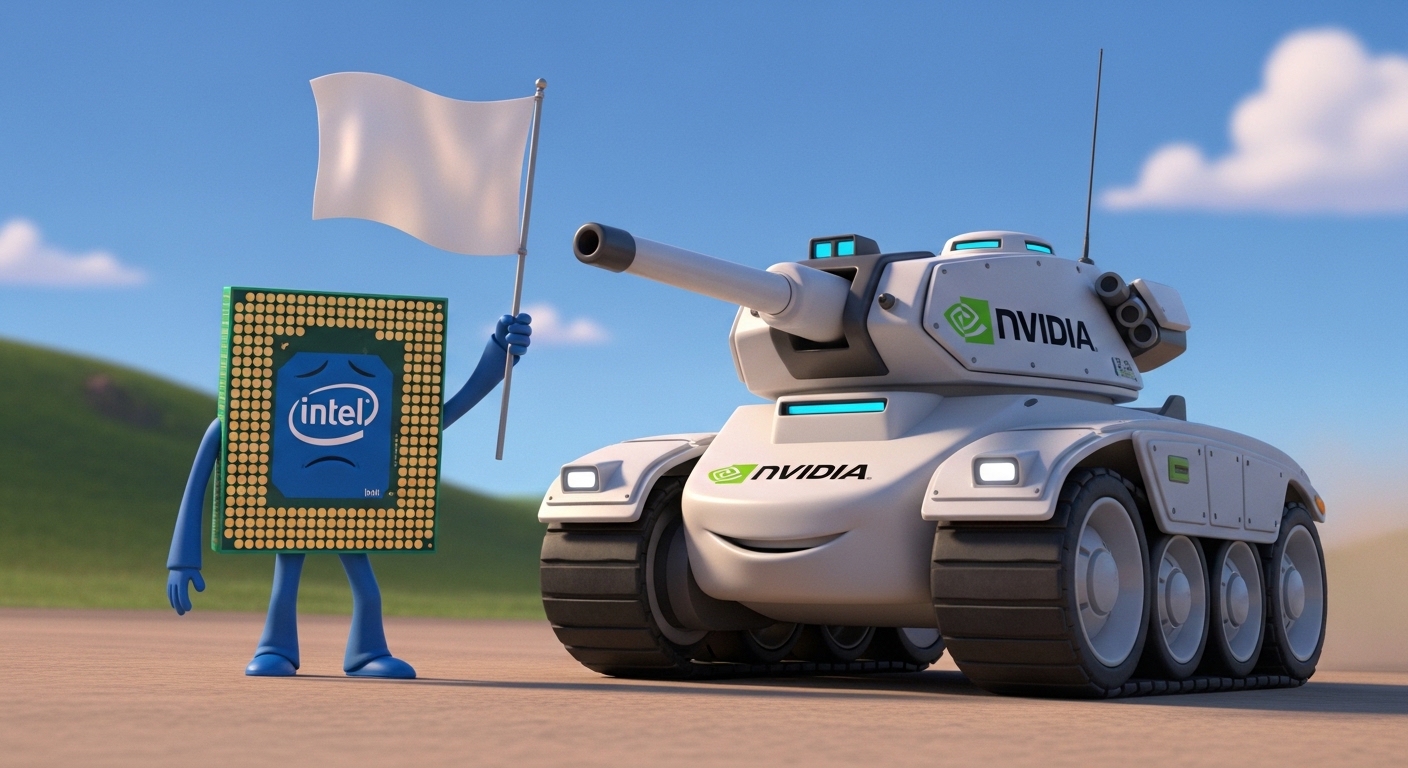
The Shifting Landscape of Defence Computing
For decades, Intel x86 processors have been the default choice for defence computing platforms — from mission computers in armoured vehicles to command-and-control systems. That era is ending. The demands of modern defence — real-time AI inference, sensor fusion, autonomous decision-making, and edge analytics — have fundamentally outgrown what traditional CPU architectures can deliver.
The question is no longer whether defence platforms need GPU-accelerated computing. The question is how quickly programmes can transition before capability gaps become operational risks.
AI in Defence: No Longer Optional
Artificial intelligence is now a critical warfighting capability for land vehicles. The modern battlefield generates data at rates that overwhelm human operators — multiple camera feeds, LIDAR point clouds, electronic warfare signals, radio traffic, and tactical data links all arriving simultaneously.
Land vehicle crews need AI to:
- Process and fuse sensor data faster than any human team can manage
- Detect and classify threats in real time from electro-optical, infrared, and radar feeds
- Provide voice-driven interfaces so crews can query systems without taking hands off controls
- Generate situational awareness from disparate information sources into a unified picture
- Run predictive analytics for route planning, threat assessment, and logistics
Without GPU-accelerated AI, these capabilities are either impossible or so degraded as to be operationally irrelevant.
Where Intel Falls Short
1. AI Inference Performance
Intel CPUs were designed for serial, general-purpose computation. AI workloads — particularly deep neural network inference — are massively parallel by nature. Running inference on an Intel CPU is like trying to move a mountain with a shovel when a bulldozer is available.
graph LR
    A[AI Inference Request] --> B{Processor Architecture}
    B -->|Intel CPU| C[Sequential Processing]
    B -->|NVIDIA GPU| D[Massively Parallel Processing]
    C --> E[❌ High Latency
Low Throughput]
    D --> F[✅ Low Latency
High Throughput]
    style C fill:#ff6b6b,color:#fff
    style D fill:#00c853,color:#fff
    style E fill:#ff6b6b,color:#fff
    style F fill:#00c853,color:#fff
2. Throughput for Real-Time Object Detection
Modern defence AI models such as YOLO, RetinaNet, and transformer-based detectors require billions of operations per frame. At the operational tempo of a land vehicle — processing 30+ frames per second from multiple cameras — Intel CPUs cannot keep pace.
xychart-beta
    title "Object Detection Throughput (Frames Per Second)"
    x-axis ["i7-13700", "Xeon W-2295", "Jetson Orin", "RTX 4000 Ada", "A100"]
    y-axis "FPS (YOLOv8 1080p)" 0 --> 350
    bar [8, 12, 85, 210, 340]
An Intel Core i7 manages barely 8 FPS on a YOLOv8 detection model at 1080p — unusable for real-time threat detection. The NVIDIA Jetson Orin, designed for edge deployment in exactly these environments, delivers 85 FPS in a fraction of the power envelope. Data-centre-class GPUs like the A100 push past 340 FPS, enabling multi-stream, multi-model pipelines that Intel hardware simply cannot support.
3. AI Training and Model Fine-Tuning
Defence forces increasingly need to fine-tune models in-theatre — adapting detection models to new terrain, new threat signatures, or new equipment. Training on Intel CPUs is orders of magnitude slower.
xychart-beta
    title "Model Training Time — ResNet-50 (ImageNet Subset, Hours)"
    x-axis ["Xeon 8380", "RTX 4090", "A100", "H100"]
    y-axis "Hours" 0 --> 90
    bar [82, 6.5, 3.2, 1.8]
What takes an Intel Xeon Platinum over 82 hours takes an NVIDIA H100 under 2 hours. In a defence context, that is the difference between a model update being ready for tomorrow's patrol or next week's deployment.
4. Power Efficiency (Performance Per Watt)
Land vehicles have constrained power budgets. Every watt consumed by computing is a watt not available for communications, active protection systems, or mobility. NVIDIA's purpose-built edge AI platforms deliver dramatically more AI performance per watt.
xychart-beta
    title "AI Performance Per Watt (TOPS/W)"
    x-axis ["i9-13900K", "Xeon W-2495X", "AGX Orin", "Orin NX", "IGX Orin"]
    y-axis "TOPS per Watt" 0 --> 5.5
    bar [0.15, 0.18, 5.0, 4.2, 3.8]
NVIDIA's Jetson AGX Orin delivers approximately 33× more AI performance per watt than Intel's best server-class processors. For a land vehicle operating on generator or battery power, this is not a marginal improvement — it is the difference between having AI capability and not having it.
5. Parallel Compute Cores
The architectural gap is fundamental. Intel CPUs have a handful of high-performance cores optimised for single-threaded workloads. NVIDIA GPUs have thousands of cores optimised for the exact parallel workloads that AI demands.
xychart-beta
    title "Parallel Compute Cores Available for AI Workloads"
    x-axis ["i9-13900K", "Xeon w9-3595X", "Jetson Orin", "RTX 4090", "H100"]
    y-axis "Cores" 0 --> 18000
    bar [24, 86, 2048, 16384, 16896]
Defence AI Use Cases That Demand GPU Acceleration
Voice LLM — Hands-Free Crew Interfaces
Modern large language models enable natural voice interaction with vehicle systems. A crew commander can ask: "What threats have been detected in the last 10 minutes on our eastern flank?" — and receive an immediate, synthesised verbal response drawn from fused sensor and intelligence data.
Running a voice LLM pipeline requires:
- Speech-to-text (Whisper or equivalent): ~1.5 billion parameters
- Language model (LLaMA-class): 7–70 billion parameters
- Text-to-speech synthesis: real-time audio generation
On an Intel CPU, even a 7B parameter model produces tokens at 2–5 tokens/second — painfully slow, with response latencies of 10+ seconds. On an NVIDIA Jetson AGX Orin or discrete GPU, inference runs at 30–60 tokens/second, enabling natural, conversational interaction.
xychart-beta
    title "LLM Inference Speed — 7B Parameter Model (Tokens/Second)"
    x-axis ["i9-13900K", "Xeon W-2495X", "AGX Orin", "RTX 4000 Ada", "A100"]
    y-axis "Tokens/s" 0 --> 120
    bar [4, 5, 32, 75, 110]
Real-Time Analytics and Sensor Fusion
Land vehicles carry an ever-growing sensor suite: day/night cameras, thermal imagers, laser warning receivers, radar, LIDAR, acoustic sensors, and CBRN detectors. Fusing this data in real time to generate a coherent operating picture requires enormous parallel compute.
flowchart TD
    subgraph Sensors
        A[EO/IR Cameras]
        B[LIDAR]
        C[Radar]
        D[Acoustic Sensors]
        E[CBRN Detectors]
        F[Radio/SIGINT]
    end

    subgraph GPU_Processing["NVIDIA GPU Processing Pipeline"]
        G[Object Detection & Classification]
        H[Point Cloud Processing]
        I[Track Correlation & Fusion]
        J[Threat Assessment AI]
        K[Natural Language Generation]
    end

    subgraph Outputs
        L[Common Operating Picture]
        M[Voice Alerts to Crew]
        N[Automated Reports]
        O[Threat Warnings]
    end

    A --> G
    B --> H
    C --> I
    D --> I
    E --> J
    F --> J
    G --> I
    H --> I
    I --> J
    J --> K
    J --> L
    K --> M
    K --> N
    J --> O

    style GPU_Processing fill:#76b900,color:#fff,stroke:#333
An Intel CPU can process perhaps one or two of these pipelines in real time. An NVIDIA GPU handles all of them concurrently, with headroom for additional models as new capabilities are deployed.
Situational Awareness and Autonomous Navigation
AI-powered situational awareness delivers:
- 360° threat detection from fused camera and sensor feeds
- Automatic target recognition (ATR) reducing operator cognitive load
- Route analysis using terrain classification from satellite and LIDAR data
- Convoy autonomy with leader-follower and GPS-denied navigation
- Predictive maintenance analysing vehicle telemetry in real time
These workloads are inherently parallel and latency-sensitive. A 200ms delay in threat detection at 60 km/h means the vehicle has moved over 3 metres — potentially the difference between triggering a countermeasure in time and not.
xychart-beta
    title "End-to-End Threat Detection Latency (Milliseconds)"
    x-axis ["i7-13700", "Xeon W-2295", "Jetson Orin", "RTX 4000 Ada", "A100"]
    y-axis "Latency (ms)" 0 --> 500
    bar [420, 310, 45, 22, 12]
The NVIDIA Defence Ecosystem
NVIDIA is not simply offering faster processors. They provide a complete defence AI ecosystem:
| Capability | NVIDIA Platform | Intel Equivalent |
|---|---|---|
| Edge AI Inference | Jetson AGX Orin (275 TOPS) | None comparable |
| Industrial/Defence Grade | IGX Orin (functional safety) | None comparable |
| AI Software Framework | CUDA, TensorRT, Triton | OpenVINO (limited) |
| Pre-trained Defence Models | TAO Toolkit, Metropolis | None |
| Sensor Fusion SDK | DeepStream, Isaac | None |
| Digital Twin / Simulation | Omniverse | None |
| LLM Deployment | NeMo, TensorRT-LLM | None comparable |
Intel's OpenVINO toolkit exists but is constrained by the fundamental hardware limitations underneath. Optimising a model to run 20% faster on hardware that is 10–40× slower than the alternative does not close the gap.
The Total Cost of Ownership Argument
Defence procurement often defaults to Intel because of perceived lower unit costs and supply chain familiarity. This argument collapses under scrutiny:
pie title "True Cost Breakdown — AI-Capable Vehicle Computing (10-Year Lifecycle)"
    "Hardware Acquisition" : 15
    "Software & Integration" : 25
    "Power & Cooling" : 10
    "Capability Gap (Ops Cost)" : 30
    "Upgrade & Refresh Cycles" : 20
The largest cost is not the hardware — it is the operational cost of reduced capability. A vehicle fleet without real-time AI is a fleet that requires more personnel, makes slower decisions, and is more vulnerable to modern threats. The 30% attributed to capability gaps represents additional manpower, slower decision cycles, and increased vulnerability that a GPU-accelerated platform eliminates.
The Path Forward
Defence programmes specifying computing platforms today must acknowledge the architectural reality:
AI is the primary workload — not office productivity, not database queries, not web serving. Vehicle mission computers must be optimised for inference first.
Intel CPUs serve as host processors — managing I/O, networking, and system management — but they are no longer the compute engine for the capabilities that matter most.
NVIDIA GPU/SoC acceleration is the baseline — not a nice-to-have option, not a future upgrade path, but a Day 1 requirement for any platform expected to remain relevant through its service life.
Software ecosystems matter — CUDA's maturity, TensorRT's optimisation capabilities, and the breadth of NVIDIA's defence-focused tooling create a development velocity that Intel cannot match.
The defence platforms being specified today will serve for 15–25 years. Choosing Intel-only architectures in 2026 guarantees those platforms will be incapable of running the AI workloads that will define the battlefield of the 2030s and beyond.
Conclusion
Intel CPUs served defence computing well in an era of deterministic, sequential processing. That era is over. The convergence of AI, autonomy, and information advantage on the modern battlefield demands a computing architecture purpose-built for parallel, high-throughput inference.
NVIDIA's platforms — from the edge-deployable Jetson Orin family to the data-centre-class Hopper architecture — deliver 10× to 40× the AI performance of equivalent Intel hardware at a fraction of the power consumption.
For land vehicle programmes, the calculus is straightforward: GPU-accelerated computing is not a technology choice. It is an operational necessity.
Astute Systems' Position: This is why Astute Systems will never build an Intel-based system. We regard Intel as a legacy technology — a relic of an era before AI defined the battlefield. Every product we develop is engineered from the ground up on NVIDIA-accelerated architectures because we refuse to deliver platforms that are obsolete on arrival. Our customers deserve computing that meets the demands of tomorrow's fight, not yesterday's procurement habits.
Astute Systems delivers GPU-accelerated defence computing solutions for land vehicle programmes. Our MediaX platform is built from the ground up for NVIDIA-accelerated AI at the tactical edge. Contact us to discuss your programme requirements.