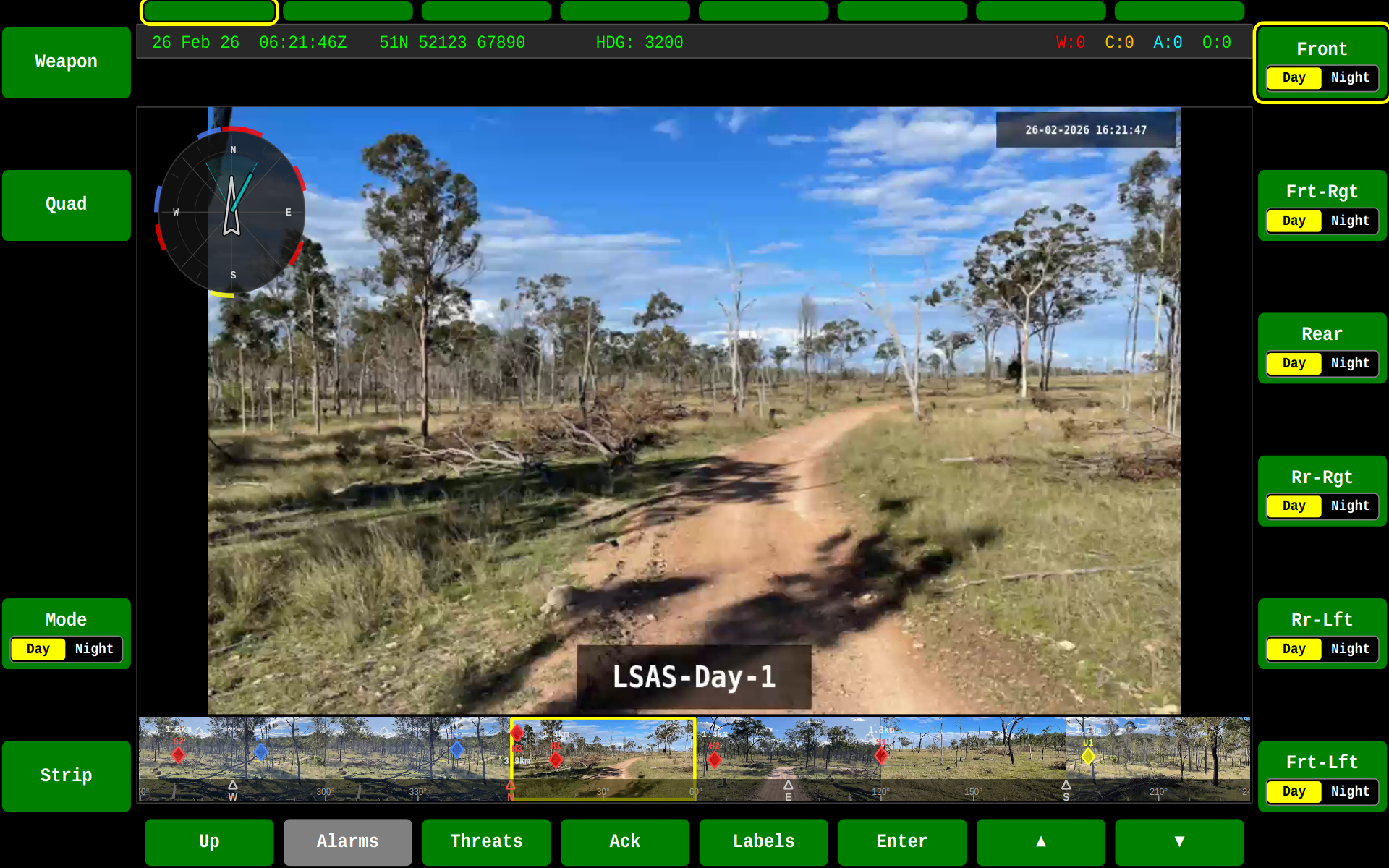
Modern land warfare is an information war. The side that sees more, processes faster, and acts with greater precision wins not always the side with the most platforms or the largest force. This shift has made AI-powered situational awareness the defining capability of land vehicle programmes in 2026 and beyond.
The question defence forces and prime contractors are now asking is not whether AI improves situational awareness in land operations. The evidence is unambiguous. The question is how — and which architectures, platforms, and software stacks are actually capable of delivering that improvement in the field, not just in a demonstration environment.
This article addresses that question directly, drawing on Astute Systems' operational experience including the deployment of the GXA-1 AI mission system in Ukraine and the proven integration of the A.T.L.A.S Digital Crew MediaX video streaming solution on a UK Land Vehicle Programme.
What Is Situational Awareness in a Land Vehicle Context?
Situational awareness (SA) in land military operations refers to a crew's ability to understand what is happening in and around their platform — threats, terrain, friendly forces, and mission status — and to act on that understanding faster than an adversary can respond.
Traditionally, SA was built from three things: eyes out of the hatch, radio communications, and map overlays updated by hand. Today's battlespace demands something fundamentally different. A modern armoured vehicle may carry:
- Multiple electro-optical and infrared camera feeds
- Laser warning receivers
- Radar and LIDAR sensors
- Acoustic detection systems
- Radio and SIGINT receivers
- GPS and positioning systems
- CBRN detection equipment
- Data links to higher command and adjacent units
No human crew of three or four can process all of this information simultaneously, prioritise threats correctly, and maintain control of the vehicle. AI does not replace the crew. It makes the crew superhuman.
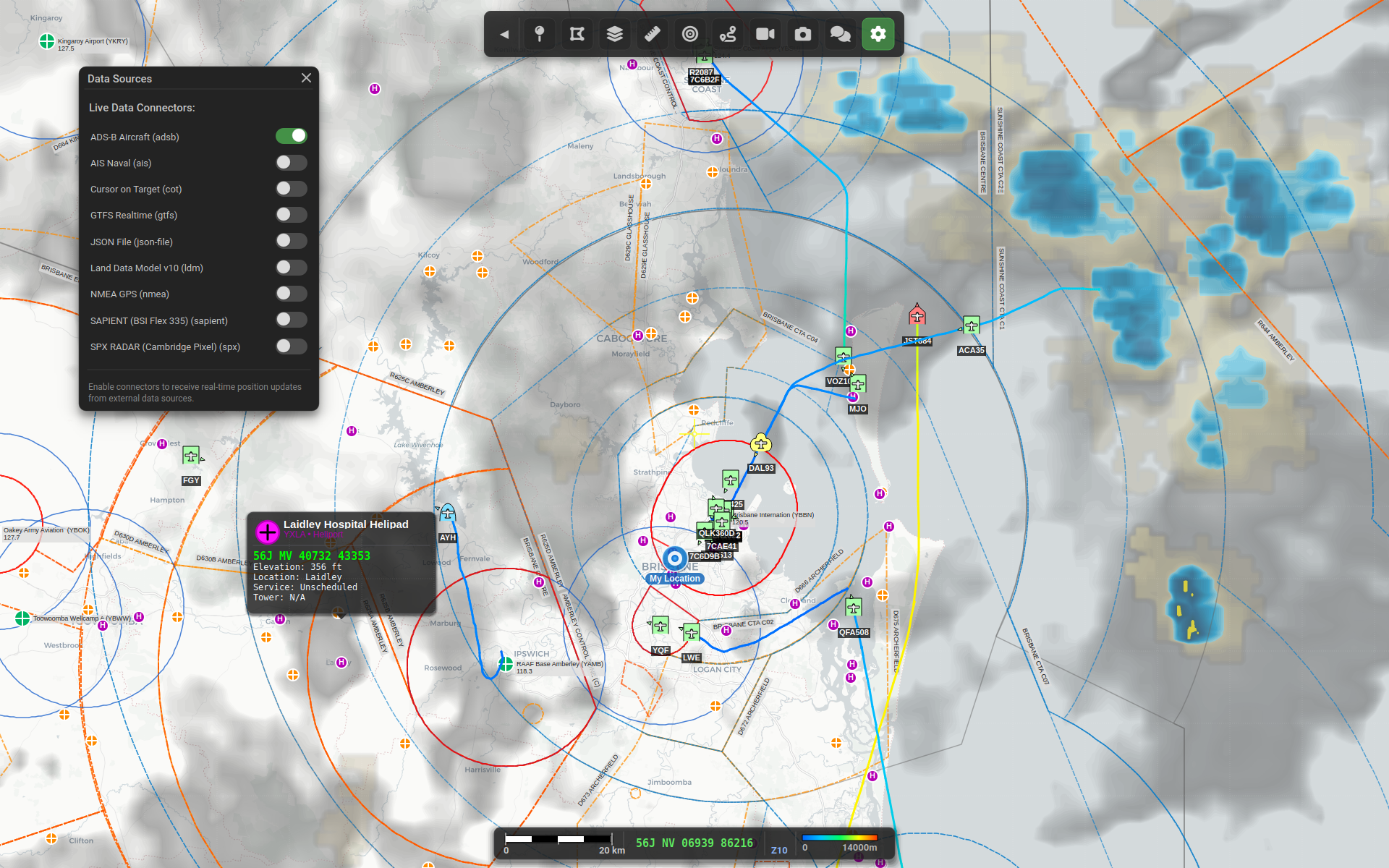
T.A.L.O.S ADS-B Air Traffic monitoring
The Three Layers of AI-Enabled Situational Awareness
AI improves situational awareness across three distinct layers: sensor processing, data fusion, and decision support. Understanding each layer is essential for systems engineers and prime contractors specifying land vehicle architectures to DEF STAN 23-009.
Layer 1: Sensor Processing — Seeing More
The first layer is raw perception. AI dramatically improves what a vehicle can detect and at what range, in what conditions, and at what speed.
Object Detection and Classification
Modern neural networks — including YOLO-class and transformer-based detectors — can identify and classify threats from video feeds in real time. This includes distinguishing between vehicle types, personnel, weapons systems, and non-threat objects across day, night, and adverse weather conditions.
On an NVIDIA Jetson AGX Orin — the compute backbone of the Astute Systems GXA-1 — these models run at over 85 frames per second. A platform with four cameras in operation is therefore processing over 340 frames of classified, structured threat data every second. No human crew can match this.
Thermal and Infrared Analysis
AI models trained on thermal and infrared imagery detect heat signatures that electro-optical cameras miss entirely — camouflaged vehicles, buried IEDs, personnel concealed in foliage, and hot exhaust signatures from recently vacated positions. These models run in parallel with visible-spectrum detection, with both outputs fused into a unified threat picture.
Acoustic Detection
Gunshot detection and vehicle acoustic signature analysis using AI can identify incoming fire direction, calibre, and in some cases the platform type, within milliseconds of the first round. This dramatically reduces the crew's reaction time for countermeasures and cover.
Layer 2: Data Fusion — Understanding More
Raw sensor data is not situational awareness. A thermal contact is not a threat. A noise is not an attack. Situational awareness is the interpretation of fused, correlated data — and this is where AI's value compounds significantly.
Multi-Sensor Fusion
The T.A.L.O.S Land Operating System, Astute Systems' battlefield management software, integrates sensor data from multiple sources — onboard and off-board — into a single common operating picture (COP). Tracks are initiated when multiple sensors agree, reducing false positives. Contacts are aged and removed automatically when they drop below confidence thresholds.
This is not a feature available in legacy command and control systems that depend on manually updated digital maps. T.A.L.O.S processes sensor data continuously, in real time, and presents a COP that reflects the actual tactical situation — not the situation as it was when someone last pressed a button.
Video Streaming and Distribution — A.T.L.A.S Proven in the UK
On a UK Land Vehicle Programme, Astute Systems' A.T.L.A.S Digital Crew solution delivered DEF STAN 00-082 compliant video streaming across the platform — distributing feeds from all onboard sensors to all crew positions simultaneously. Every crew member, from commander to gunner to driver, sees the same sensor picture, at the same time, with no lag.
This matters because situational awareness is not individual — it is collective. A commander who can see what the driver sees, and a gunner who can see what the commander's sight is tracking, makes better decisions faster. A.T.L.A.S achieves this within a fully GVA-compliant open architecture, meaning it integrates cleanly with existing platform electronics without proprietary lock-in.
GPS-Denied Operations
In contested environments increasingly the reality rather than the exception — GPS signals are jammed, spoofed, or unavailable. AI-powered inertial navigation, visual odometry, and terrain correlation maintain accurate position estimation even when satellite-based navigation is denied. T.A.L.O.S integrates these inputs to maintain a reliable COP regardless of communications and positioning infrastructure.
Layer 3: Decision Support — Acting Faster
The third layer is where AI translates awareness into action. This is the most operationally significant layer, and the least mature across the industry — which creates a significant advantage for platforms that implement it correctly.
Threat Prioritisation
When a vehicle's sensors detect multiple simultaneous contacts, the crew needs to know which one to respond to first. AI threat assessment models — trained on doctrinal engagement priorities, platform-specific vulnerability models, and real-time threat intelligence — rank contacts automatically and present the highest-priority threat to the crew with a recommended response.
This reduces the cognitive burden on crews under fire and shortens the sensor-to-decision cycle from seconds to milliseconds.
Voice-Driven Crew Interfaces — H.E.R.M.E.S
Astute Systems' H.E.R.M.E.S (Hardened Edge Relay & Machine-intelligent Encrypted Speech) provides secure, military-grade VoIP communications with AI-assisted voice capabilities for GVA platforms. A crew commander can query the vehicle's systems verbally — hands remaining on controls — and receive synthesised verbal responses drawn from the fused sensor and intelligence picture.
The ability to ask "What contacts have been detected in the last two minutes on our northern arc?" and receive an immediate answer while manoeuvring under fire is a capability with no precedent in analogue or first-generation digital vehicle electronics.
Predictive Maintenance and Platform Health
Situational awareness extends to the platform itself. Astute Systems' Health and Usage Monitoring System (HUMS) provides real-time condition monitoring of critical vehicle components — engines, transmissions, drivetrains, and power systems. AI-driven predictive analytics identify degradation patterns before they become failures, enabling pre-mission maintenance decisions that keep platforms operational when it matters.
A vehicle that breaks down on the objective is not a situational awareness failure. It is a predictive maintenance failure. HUMS closes that gap.
Why Edge AI Changes Everything
The critical architectural insight that separates modern AI-enabled platforms from legacy systems is where the inference runs.
Traditional approaches stream raw sensor data back to a remote server or cloud environment for processing, then return the result to the platform. This architecture has three fatal flaws in a contested land environment:
- Latency — round-trip transmission adds hundreds of milliseconds of delay. At tactical vehicle speeds, this is operationally unacceptable.
- Communications dependency — if the datalink is jammed, degraded, or congested, the capability disappears entirely.
- Bandwidth consumption — streaming multiple high-definition video feeds from multiple platforms simultaneously saturates tactical communications networks.
Edge AI eliminates all three problems.
The GXA-1 AI mission system runs inference directly on the platform, on NVIDIA Jetson silicon, with no dependence on external connectivity for its core AI functions. Object detection, sensor fusion, threat classification, and voice interface processing all happen onboard, in real time, regardless of communications availability.
This is not an incremental improvement on legacy architectures. It is a fundamental rethinking of where computation happens — and it is the only approach that remains effective in the denied, degraded, intermittent, and limited (DDIL) communications environments that characterise modern land operations.
Proven in the Field — GXA-1 Deployed in Ukraine
The GXA-1 has been deployed in Ukraine as part of a weapons upgrade programme, operating in one of the most demanding real-world operational environments on earth. Modern warfare in Ukraine is characterised by dense electronic warfare, contested airspace, GPS denial, and high-intensity attrition operations where platform reliability and AI performance are tested to destruction — literally.
The GXA-1's deployment in this environment validates two things that no laboratory qualification programme can: first, that the hardware survives the shock, vibration, temperature, and electromagnetic environment of active operations; second, that the AI capabilities it enables — detection, classification, and response support perform at operational tempo under the worst conditions.
For prime contractors and procurement agencies evaluating AI mission systems, this is the only evidence that matters. The GXA-1 is not a technology demonstrator. It is a fielded system, battle-tested, operating today.
What This Means for GVA Programmes
For engineers and programme managers working to DEF STAN 23-009 — the UK's mandated Generic Vehicle Architecture standard the integration of AI-enabled situational awareness raises specific architectural questions.
Open Architecture Is Non-Negotiable
AI capabilities will evolve faster than any platform's through-life cycle. A vehicle specified today will be in service in the 2040s. The AI models available in 2040 will be unrecognisable compared to today's. The only architecture that can accommodate this rate of change is one built on open standards, with modular software and hardware components that can be upgraded without redesigning the platform.
T.A.L.O.S and A.T.L.A.S are both built on GVA-compliant open architectures. New AI capabilities can be integrated via software update, without hardware replacement, without proprietary API dependencies, and without vendor lock-in.
Data Distribution Service (DDS) Is the Integration Layer
The Data Distribution Service underpins GVA's data sharing model, enabling real-time, publish-subscribe communication between vehicle subsystems. Astute Systems' Astute DDS implementation provides the integration layer between AI inference outputs — from the GXA-1 — and the broader vehicle architecture, including displays, communications systems, and weapons interfaces.
For prime contractors building on GVA, this means AI-generated threat data, fused sensor tracks, and system status outputs flow natively into the vehicle's existing data architecture. Integration cost and risk are minimised.
The Land Data Model (LDM) as the Common Language
The LDM defines how data is structured and shared across GVA-compliant systems. Astute Systems' full-stack GVA software — including T.A.L.O.S, A.T.L.A.S, H.E.R.M.E.S, and HUMS — implements the LDM natively. AI outputs are expressed in LDM-compliant data structures from the point of inference, ensuring interoperability with any other LDM-compliant system on the network — including allied platforms, command posts, and higher echelon C4ISR infrastructure.
The Competitive Landscape
Several established defence prime contractors offer battlefield management and situational awareness software. Most were designed in an era before edge AI was technically feasible, and their architectures reflect that heritage — server-centric processing, proprietary data formats, and integration approaches that predate the GVA standard.
Retrofitting AI capability into these architectures is technically possible but operationally compromised. The latency, communications dependency, and integration complexity of bolt-on AI are precisely the failure modes that edge-native architectures like the GXA-1 and T.A.L.O.S are designed to eliminate.
For programmes being designed today — whether new-build or major upgrade — specifying edge-native AI from the outset is not only technically superior. It is significantly lower risk and lower whole-life cost than integrating AI as an afterthought into a legacy architecture.
Summary: What AI Actually Delivers on the Land Battlefield
To ground this discussion in operational reality, the table below summarises the specific improvements AI-enabled situational awareness delivers across the sensor-to-decision chain:
| Capability | Legacy Platform | AI-Enabled Platform (GXA-1 / T.A.L.O.S) |
|---|---|---|
| Threat detection range | Crew visual + thermal optics | AI-augmented multi-sensor detection, extended range, all conditions |
| Threat classification | Crew judgement, seconds to minutes | Automated, milliseconds, multiple simultaneous contacts |
| Sensor fusion | Manual, crew-dependent | Automatic, continuous, multi-source |
| Common operating picture | Manually updated, intermittent | Real-time, sensor-driven, always current |
| Voice interface | Radio comms only | AI voice, hands-free crew queries, encrypted |
| GPS-denied navigation | Degraded to dead reckoning | AI-maintained position estimation |
| Platform health | Scheduled maintenance | Predictive, real-time, AI-driven |
| Communications dependency | High — SA degrades in DDIL | Low — edge AI functions independently |
Astute Systems' Position
We have designed and built AI-enabled situational awareness capabilities for land platforms from the ground up — not adapted legacy systems, not added AI as a marketing label to existing products, but engineered edge-native AI into military-grade hardware and GVA-compliant software that is now proven in operational deployment.
The GXA-1's service in Ukraine and A.T.L.A.S's performance on a UK Land Vehicle Programme represent the validation that matters — not benchmark sheets, not demonstration environments, but operational use in conditions that test systems beyond any laboratory specification.
For prime contractors, system integrators, and programme offices evaluating AI situational awareness capabilities for land vehicle programmes, we invite you to engage directly. The question is not whether your platform needs AI-enabled situational awareness. It does. The question is which system has already proven it can deliver.
Contact Astute Systems to discuss your programme requirements. Learn more about the GXA-1 AI Mission System, T.A.L.O.S Land Operating System, A.T.L.A.S Digital Crew, and Generic Vehicle Architecture solutions.