SAPIENT
Plug-and-Play Autonomous Sensing for TALOS and ATLAS
Modern perimeter protection and ISTAR missions depend on sensors that can think for themselves — detecting, classifying, and reporting without a human re-configuring every camera and radar by hand. SAPIENT (Sensing for Asset Protection with Integrated Electronic Networked Technology) is the UK Defense standard that makes this possible, and it is a first-class citizen across the Astute Systems product family: it plugs directly into TALOS for battlespace visualization, hands its tracks off seamlessly to the GVA threat system through the ATLAS Digital Crew suite, and fuses and persists at the tactical edge — right down to vehicle-mounted compute such as the BushNET central nervous system.
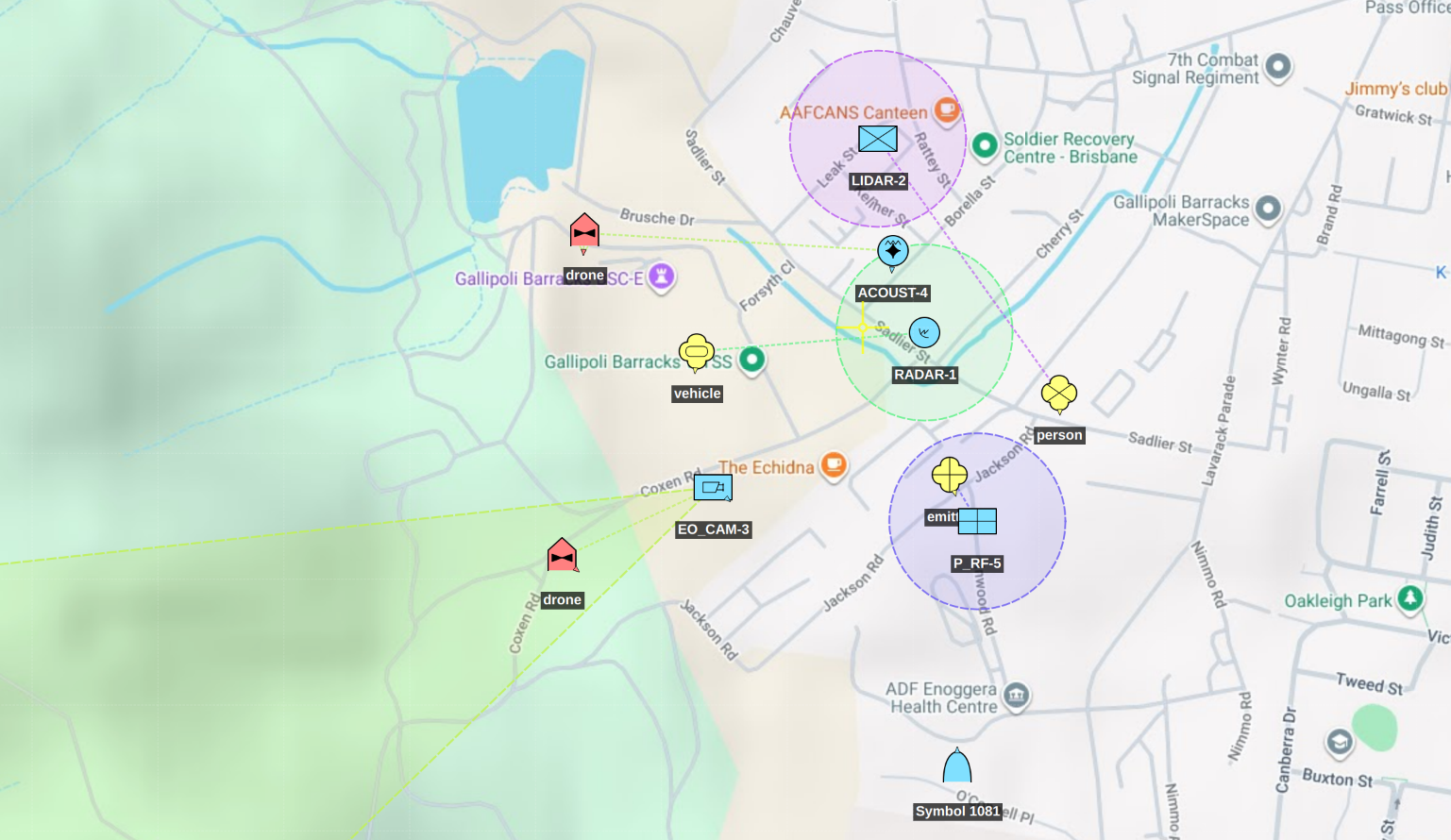
What Is SAPIENT?
SAPIENT is published as BSI Flex 335 v2.0, developed by Dstl (the Defense Science and Technology Laboratory). It defines a complete protocol for autonomous sensor integration, structured around two roles:
- ASM (Autonomous Sensor Module) — any sensor node: camera, radar, LIDAR, acoustic array, seismic sensor, RF detector, or mobile platform. Each ASM has onboard AI that detects and classifies targets and reports autonomously.
- DFN (Data Fusion Node) — the coordinator that receives detections from every ASM, fuses them into a single coherent picture, and can task sensors to investigate.
A SAPIENT sensor registers with the DFN on connection, self-describing its node type, capabilities, operating modes, and coverage area. Detections carry multi-level classification with confidence scores, behavior analysis, velocity, and predicted location — a complete intelligence product generated at the sensor edge, not just a dot on a map.
SAPIENT vs. AIM vs. CoT
SAPIENT sits alongside two other protocols already supported in the Astute Systems stack, and it is worth being precise about what each one is for:
| Protocol | Answers | Intelligence | Sensor control |
|---|---|---|---|
| AIM (fires messaging standard) | Where should fires land, and who is calling and clearing the mission? | Fire mission requests, target data, and clearance/acknowledgment between observers and fire support/weapon systems | Tasks weapon systems, not sensors |
| CoT (Cursor on Target) | What is where? | Simple position/affiliation reports for dismounts, vehicles, and command posts | None |
| SAPIENT (BSI Flex 335 v2.0) | What can my sensors see, what have they found, and what should they do next? | Multi-level AI classification, behavior, and evidence | Full — look-at, move-to, patrol, follow, mode/threshold changes |
CoT is a passive reporting protocol — a platform announces its own position and that is the extent of the exchange. AIM is active, but at the fire-mission level — it coordinates and clears fires between observers and weapon systems rather than managing sensors. SAPIENT is different again: it manages a live network of autonomous sensors that can be tasked, re-tasked, and coordinated by a central fusion node. All three protocols are complementary rather than competing — TALOS ingests all of them side by side through its connector framework, and a SAPIENT detection can be the trigger that starts an AIM fire mission or appears as a CoT contact on every operator's map, fusing every picture into one shared operating view.
Plug-and-Play with TALOS
SAPIENT was built for zero-configuration integration, and the TALOS battlespace management system (gva-app-bms) is built to match it.
- Self-describing sensors. A new SAPIENT ASM does not need to be pre-configured in TALOS. On connection it registers its node type, detection range, coverage arc, and operating modes — TALOS understands immediately what the sensor can do and starts rendering it.
- Connector-plugin architecture. The SAPIENT connector ships as an installable Qt plugin (
gva-app-bms-sapient) that TALOS'sConnectorManagerauto-discovers at startup — no rebuild, no manual wiring, drop the plugin in and the sensor feed is live. - Instant situational picture. As soon as an ASM registers, its detections appear on the TALOS map and threat list with full classification, confidence, and behavior — operators see a new sensor come online and start contributing without touching a settings screen.
The result is genuine plug-and-play: connect a SAPIENT-compliant radar, camera, or acoustic sensor to the network, and TALOS absorbs it into the common operating picture automatically.
Seamless Handoff to the GVA Threat System via ATLAS Digital Crew
A detection is only useful if it reaches the people who need to act on it. SAPIENT tracks ingested by TALOS don't stay siloed in the BMS — they flow straight into the ATLAS GVA stack:
- TALOS resolves each incoming SAPIENT
DetectionReportinto a threat entry, preserving the SAPIENT metadata — classification, confidence, RF characteristics, and behavior — rather than reducing it to a bare position. - That threat entry is published as a standard LDM v10 Battlespace Object over DDS, using the same GVA pub/sub wrappers and QoS patterns as every other GVA resource.
- The ATLAS Digital Crew suite — the DEF STAN 23-009 compliant crew-station HMI (
gva-hmi) — subscribes to the Battlespace Object topic and renders the SAPIENT-derived threat on every crew display alongside native GVA tracks, with no bespoke integration per sensor type. - Because the object rides the standard GVA data model, it is equally visible to the alarms service for threshold-based crew alerting, and to any other registered GVA consumer on the bus.
A camera or radar that only speaks SAPIENT ends up, within one hop, on the same tactical display as the vehicle's native GVA sensors and weapon systems — a single crew, a single picture, regardless of which protocol the sensor originally spoke.
Data Fusion and Persistence at the Edge
Autonomous sensing is only as good as the fusion behind it, and that fusion does not need to live in a data center. The sapient-data-fusion-node is a lightweight, non-DDS SAPIENT DFN designed to run wherever the sensors are:
- TCP ingest — accepts SAPIENT protobuf registration, status, and detection reports directly from ASMs.
- Track fusion — correlates detections across sensors into a persistent per-track and per-sensor picture (location, coverage, classification history), with configurable stale-track timeout so the picture stays current without operator housekeeping.
- Multicast republish and REST query — the fused picture is re-broadcast for consumers on the local network and queryable over a simple REST API, so downstream systems (TALOS,
sapient-web, or a custom integration) can consume it without a DDS dependency.
One DFN, one UDP multicast stream, any number of listening TALOS instances — every BMS on the mesh joins the same group and sees the same fused picture with no per-client registration:
Because every TALOS instance simply joins the multicast group, adding another vehicle or dismount to the mesh is a network-level join, not a new point-to-point integration with the DFN — the fusion node's connection count stays flat no matter how many TALOS clients are listening.
Because the fusion node is small, dependency-light, and self-contained, it is well suited to embedding directly on edge compute rather than a rear-echelon server — including on a vehicle-mounted BushNET unit acting as the platform's central nervous system. Running fusion at the point of sensing keeps detection, classification, and tasking working even when the link back to higher command is degraded or unavailable, and hands the platform a locally-persisted, already-fused picture the moment connectivity is restored.
Summary
| Capability | What it delivers |
|---|---|
| Plug-and-play with TALOS | Self-describing SAPIENT sensors auto-register; the BMS connector plugin auto-loads with no rebuild |
| Introduction & context | SAPIENT (BSI Flex 335 v2.0) complements AIM and CoT — autonomous sensor tasking vs. fires coordination vs. passive position reporting |
| Seamless GVA handoff | SAPIENT tracks become standard LDM v10 Battlespace Objects, visible on every ATLAS Digital Crew display and to the alarms service |
| Edge fusion & persistence | sapient-data-fusion-node correlates and persists tracks locally, light enough to embed on platform edge compute such as BushNET |
SAPIENT turns every connected sensor into an autonomous team member — and with TALOS and ATLAS, that sensor's picture is on the crew's screen within seconds of it joining the network.