Cursor on Target vs SAPIENT: Two Protocols for the Modern Battlefield
Introduction
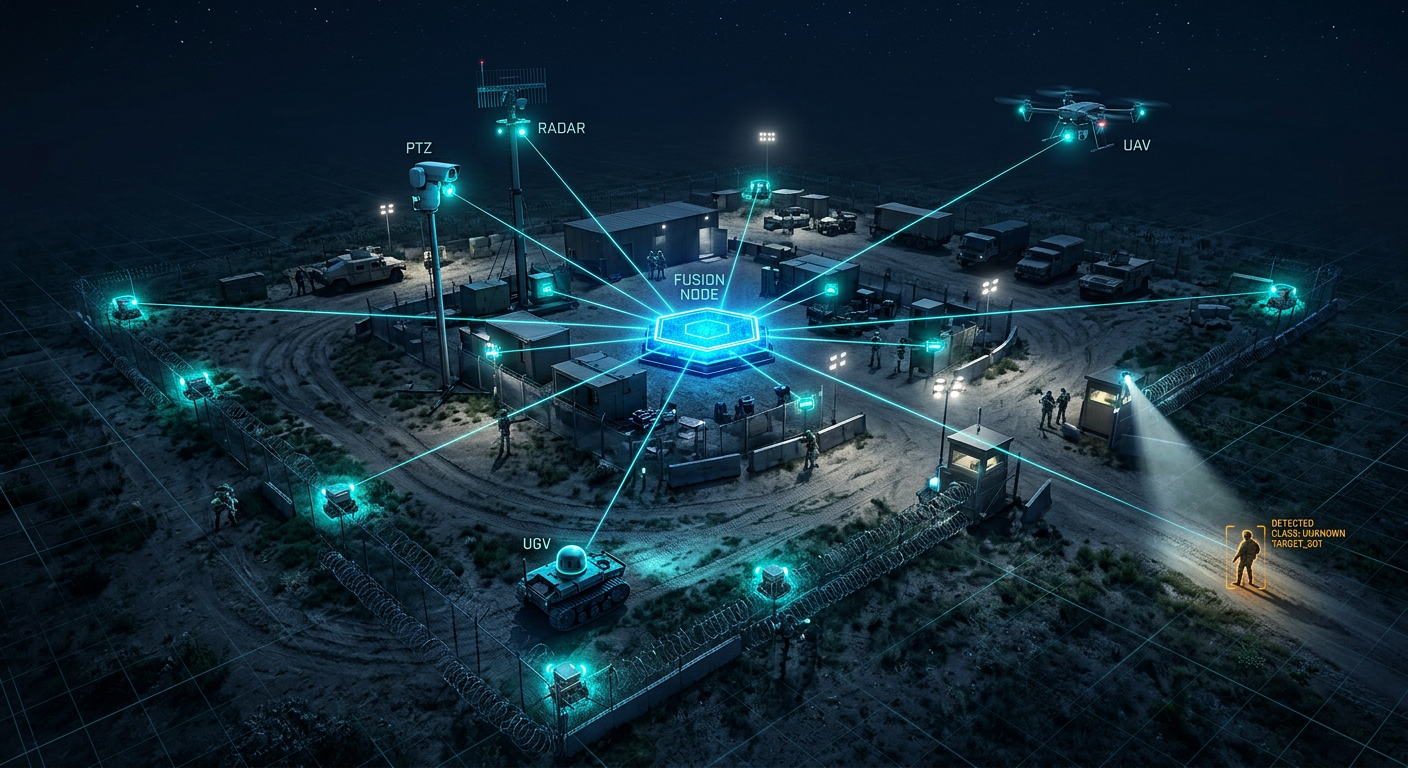
Modern defence systems generate vast amounts of data from sensors, vehicles, dismounts, and command posts. Getting the right information to the right people — and the right machines — at the right time requires standardised messaging protocols. Two prominent protocols serve this space: Cursor on Target (CoT) and SAPIENT (Sensing for Asset Protection with Integrated Electronic Networked Technology).
While both deal with situational awareness, they solve fundamentally different problems. CoT answers "what is where?" — SAPIENT answers "what can my sensors see, what have they found, and what should they do next?"
Cursor on Target (CoT) — The Basics
What It Is
Cursor on Target is an XML-based messaging format developed around 2010 by MITRE for the US Air Force Research Laboratory. It describes events as simple "what, where, when" tuples — a position on a map, who or what is there, and for how long that information is valid.
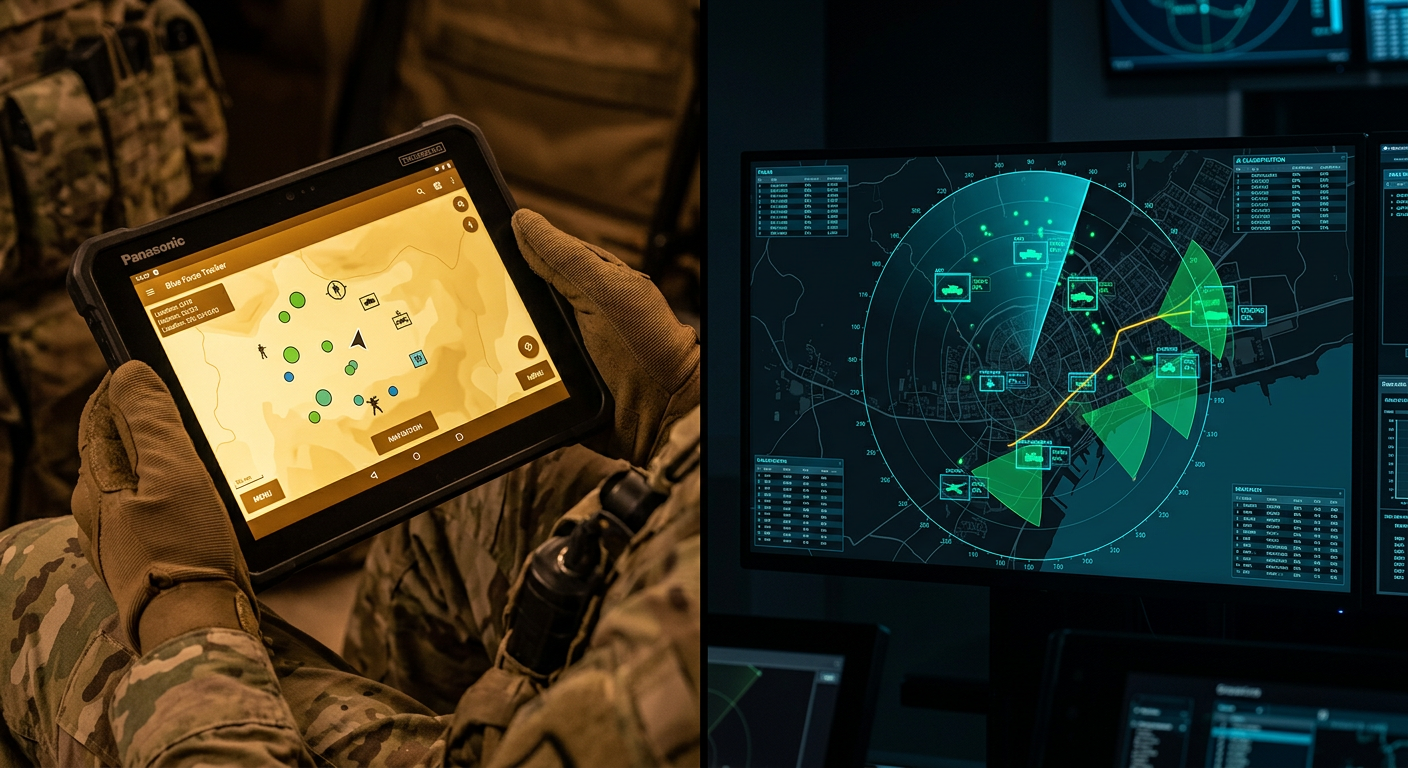
CoT is the backbone of the TAK ecosystem — the family of apps (ATAK on Android, WinTAK on Windows, iTAK on iOS) used by over 250,000 military personnel, first responders, and civil agencies worldwide.
How It Works
A CoT message is straightforward:
<event uid="ALPHA-01" type="a-f-G-U-C" time="2024-03-15T10:30:00Z"
       start="2024-03-15T10:30:00Z" stale="2024-03-15T10:35:00Z">
  <point lat="-33.8688" lon="151.2093" hae="50" ce="10" le="5"/>
  <detail>
    <contact callsign="ALPHA-01"/>
  </detail>
</event>
This says: "A friendly ground unit called ALPHA-01 is at these coordinates, accurate to 10 metres, and this information is valid for 5 minutes."
The type field encodes affiliation and category using a hierarchical code — a-f-G-U-C means "atom, friendly, ground, unit, combat." This maps directly to NATO military symbology (APP-6 / MIL-STD-2525).
What CoT Does Well
- Simplicity — human-readable XML, easy to generate from almost any system
- Ubiquity — massive installed base across NATO and Five Eyes
- Interoperability — the lowest common denominator for position sharing
- Real-time SA — UDP multicast for mesh networking, TCP for server-relayed comms
- Extensibility — the
<detail>block accepts arbitrary XML for chat messages, drawings, sensor video feeds, routes, and emergency beacons
What CoT Does Not Do
CoT is a passive reporting protocol. It tells you where things are. It cannot:
- Describe what a sensor is capable of
- Command a sensor to look somewhere or move
- Report multi-level AI classifications with confidence scores
- Manage sensor lifecycles (registration, health, mode changes)
- Coordinate autonomous sensor networks
For those capabilities, you need SAPIENT.
SAPIENT — Autonomous Sensor Management
What It Is
SAPIENT is a UK Defence standard published as BSI Flex 335 v2.0 by the British Standards Institution, developed by Dstl (the Defence Science and Technology Laboratory). It defines a complete protocol for autonomous sensor integration — enabling AI-powered sensors to self-manage, self-describe, detect and classify targets, and respond to tasking commands from a central fusion system.
Where CoT puts dots on a map, SAPIENT creates a managed network of intelligent sensors that can sense, classify, decide, move, and be directed.
The SAPIENT Architecture
SAPIENT defines two primary roles:
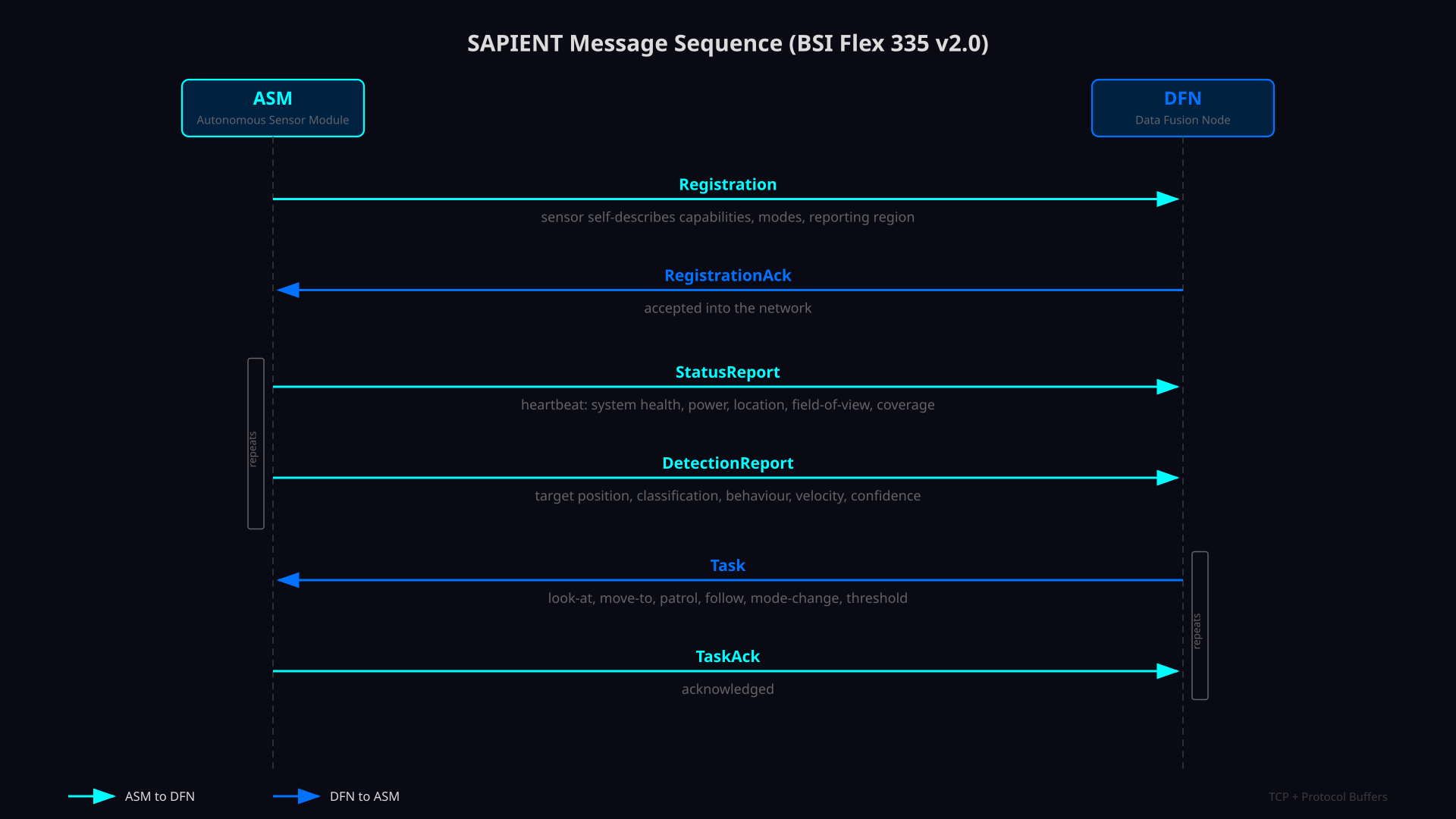
ASM (Autonomous Sensor Module) — any sensor node: a camera, RADAR, LIDAR, acoustic array, seismic sensor, RF detector, or even a human observer. Each ASM has onboard AI that processes raw data and reports detections autonomously.
DFN (Data Fusion Node) — the central coordinator that receives detections from all ASMs, fuses them into a coherent picture, and can task sensors to investigate threats.
The communication flow is structured:
Self-Describing Sensors
When a SAPIENT sensor joins the network, it registers by describing itself in detail:
- Node type — RADAR, LIDAR, Camera (EO/IR), Seismic, Acoustic, Passive RF, Chemical, Biological, Radiation, or even a Mobile Node
- Capabilities — structured data like maximum detection range, angular coverage, frequency bands, transmit power
- Operating modes — what the sensor can report in each mode, what tasking it accepts
- Reporting region — the geographic area the sensor covers
- Status definitions — how often it sends heartbeats, what fields it reports
This means the fusion system doesn't need to be pre-configured for each sensor type. A new RADAR can join the network, announce "I detect ground vehicles to 5 km with 360° coverage in Mode A, or I can focus on a 30° arc to 12 km in Mode B," and the DFN immediately understands what it has available.
Intelligent Detection
SAPIENT detection reports are far richer than a simple position fix:
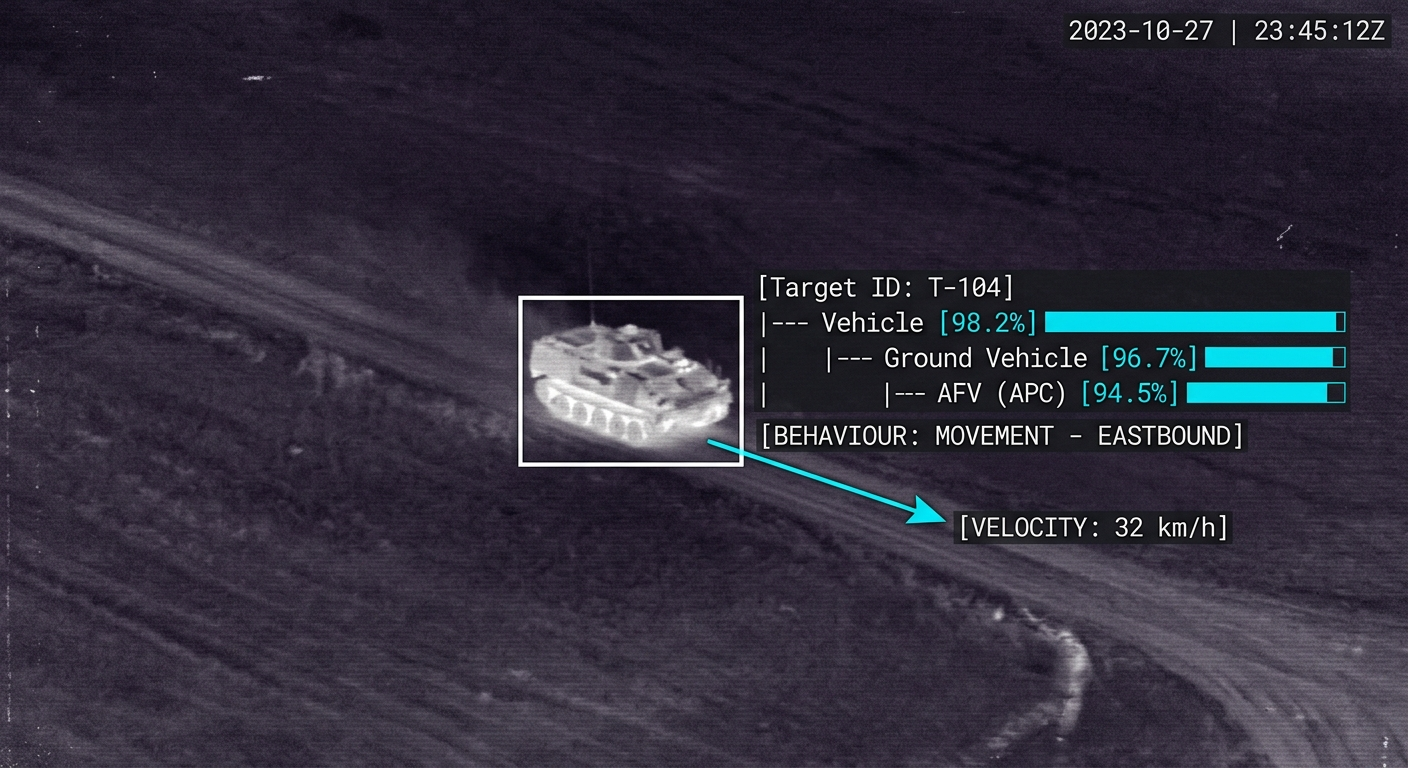
- Multi-level classification — hierarchical with confidence scores (e.g., "Vehicle: 92% → Wheeled: 85% → APC: 63%")
- Behaviour analysis — the sensor's onboard AI can report observed behaviours (loitering, approaching, retreating) with confidence
- Velocity — full 3D (east/north/up) in metres per second
- Predicted location — where the target will be at a future timestamp
- RF signal data — for electronic warfare sensors: amplitude, frequency band, pulse characteristics
- Associated evidence — URLs to captured imagery or video clips
- Cross-sensor correlation — links to related detections from other sensors
This is not a dot on a map — it's a complete intelligence product generated autonomously at the sensor edge.
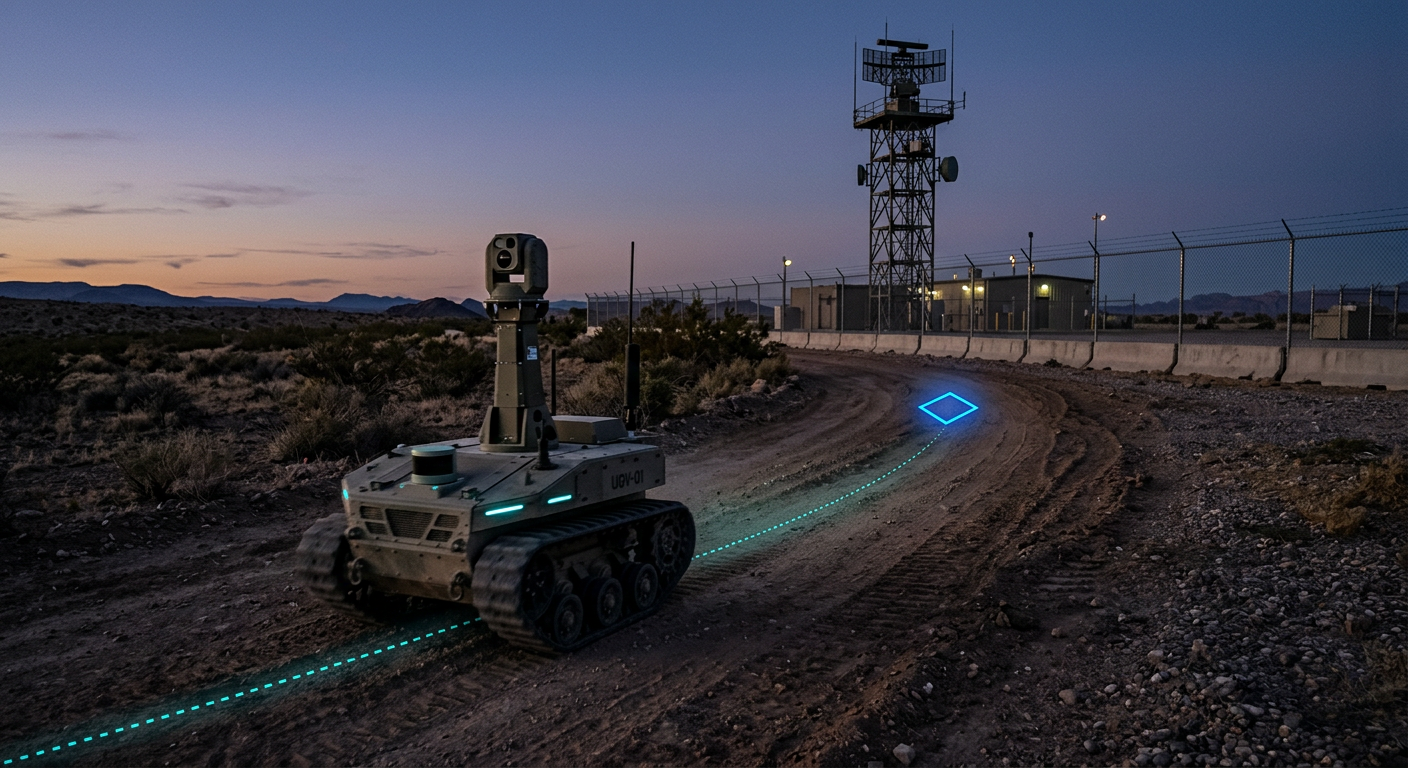
Sense and Move: The Tasking System
This is where SAPIENT truly differentiates itself. The DFN (or a human operator through the DFN) can command sensors with a rich vocabulary:
| Command | What It Does |
|---|---|
| Look At | Point a sensor at specific coordinates — direct a camera or RADAR to investigate a location |
| Move To | Command a mobile sensor (drone, UGV, mobile mast) to relocate to new coordinates |
| Patrol | Instruct a mobile node to move through a sequence of waypoints on a repeating route |
| Follow | Track a specific detected object — the sensor autonomously keeps it in view |
| Mode Change | Switch a sensor between operating modes (e.g., wide-area surveillance → focused tracking) |
| Detection Threshold | Tune sensitivity — LOW for fewer false alarms, HIGH for maximum detection |
| Classification Threshold | Adjust how confident the AI must be before reporting a classification |
| Detection Report Rate | Control how frequently the sensor reports |
Tasks include geographic regions of interest with semantic types:
- Area of Interest — prioritise detections here
- Ignore — suppress reports from this area
- Boundary — the operational boundary
- Mobile Node No-Go Area — do not move sensors here
- Mobile Node Go Area — permitted movement zones
Tasks also carry time controls (start/stop/pause with timestamps) and class/behaviour filters — for example: "In this region, only report detections classified as 'Person' with behaviour 'Loitering'."
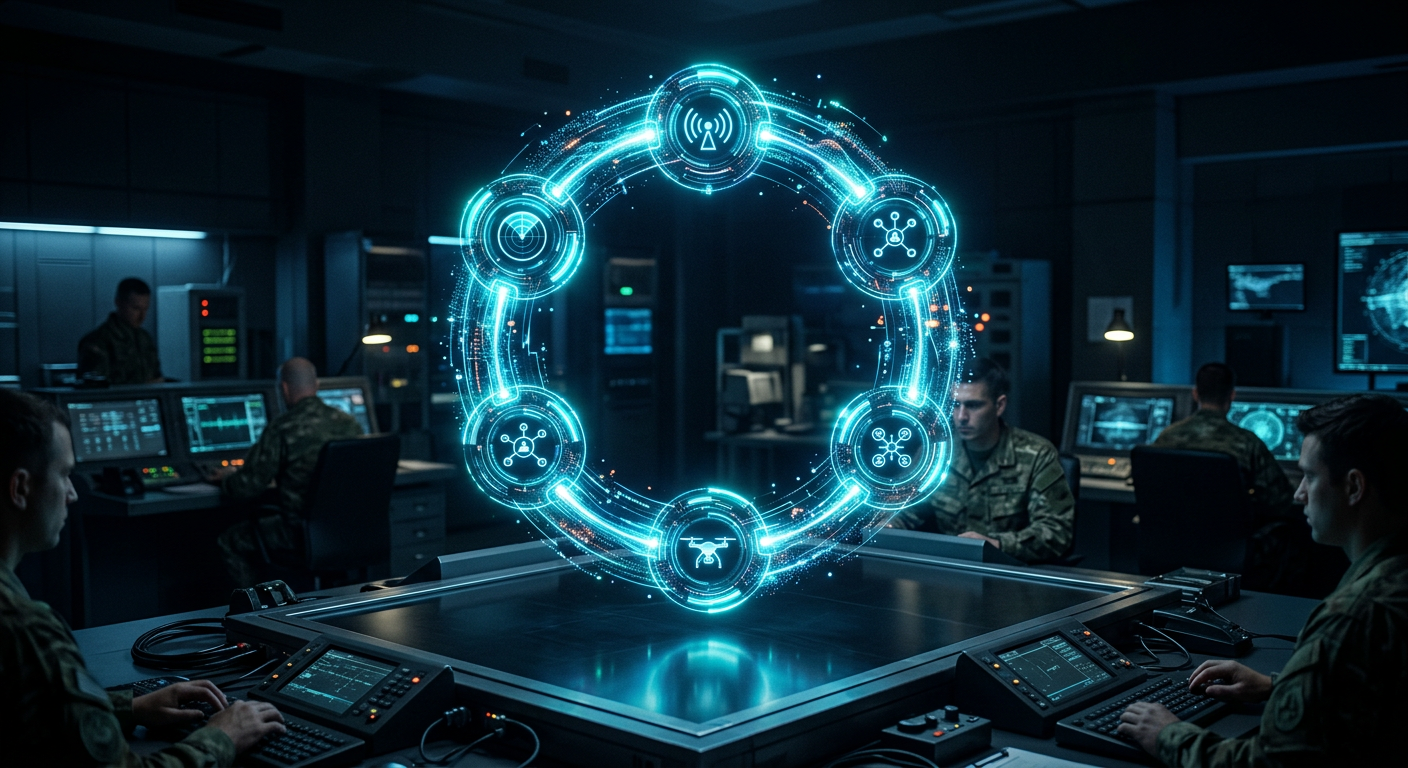
The Sense-Decide-Act Loop
SAPIENT enables a complete autonomous loop:
- Sense — ASMs detect and classify targets using onboard AI
- Report — detections flow to the DFN with full classification and evidence
- Fuse — the DFN correlates detections from multiple sensors
- Decide — the DFN (or operator) determines what needs investigation
- Task — commands flow back to ASMs: "Camera 3, look at grid reference X. Drone 1, move to overwatch position Y."
- Act — sensors autonomously execute tasking, confirming with acknowledgements
This loop runs continuously. Sensors that detect a threat can trigger other sensors to corroborate, and mobile assets can be repositioned to cover gaps — all within a standardised protocol.
SAPIENT Is Not Teleoperation
A common question: can SAPIENT be used to teleoperate a drone or UGV? The short answer is no — and this is by design.
Teleoperation means continuous, real-time, low-latency manual control — a human operator with a joystick steering a platform frame-by-frame, with live video feedback and millisecond response times. Think: flying a drone through a window, or steering a bomb-disposal robot around an obstacle.
SAPIENT tasking is fundamentally different. It operates at the mission level, not the control level:
| Teleoperation | SAPIENT Tasking | |
|---|---|---|
| Control granularity | Continuous inputs every 20–50 ms (steering, throttle, pan/tilt rates) | Single command: "move to grid ref X" or "patrol waypoints A→B→C" |
| Latency tolerance | Milliseconds — operator in the loop at all times | Seconds to minutes — the platform executes autonomously |
| Autonomy | Zero — platform does exactly what the operator commands | High — the ASM decides how to navigate, avoid obstacles, and execute |
| Feedback | Live video stream + real-time telemetry | Detection reports + periodic status heartbeats |
| Safety mechanisms | Dead-man switch, connection-loss failsafe, emergency stop | Task acknowledgement only — no continuous link required |
When SAPIENT sends a move_to command, the mobile node receives a destination and autonomously plans its route, avoids obstacles, and navigates there. There is no joystick. There is no video-in-the-loop. The operator says where, not how.
Protocols designed for teleoperation include:
- STANAG 4586 — NATO standard for UAV control stations (continuous command/telemetry links)
- JAUS (Joint Architecture for Unmanned Systems) — fine-grained velocity, waypoint, and manipulator control
- ROS 2 (Robot Operating System) —
cmd_veltopics for real-time velocity commands, joint state control - Bespoke vendor links — most military UGVs and drones use proprietary low-latency video + control channels
Where SAPIENT and teleoperation complement each other:
A realistic operational concept might use both. A surveillance drone operates in autonomous SAPIENT mode — patrolling a route, reporting detections, accepting look_at tasking from the DFN. When the DFN identifies a high-priority target requiring close investigation, an operator switches the drone to teleoperation mode via STANAG 4586 or a vendor link, flies it manually for the close pass, then hands it back to SAPIENT for autonomous patrol. SAPIENT manages the "what" and "where" of the mission; teleoperation handles the moments that require a human in the loop.
Neither CoT nor SAPIENT replaces a teleoperation protocol. CoT tells you where the platform is. SAPIENT tells it where to go. Teleoperation lets a human drive it there directly.
When to Use Each Protocol
Use CoT When:
- You need to share positions between dismounts, vehicles, and command posts
- You're integrating with the TAK ecosystem (ATAK, WinTAK, TAK Server)
- Your requirement is situational awareness — knowing where friendly and hostile forces are
- You need chat, drawings, routes, and markers on a shared map
- You want the simplest possible integration for position reporting
- You're working in a coalition environment where TAK is the common tool
Use SAPIENT When:
- You're building an autonomous sensor network — multiple sensors that self-manage
- Your sensors have onboard AI performing detection and classification
- You need to task sensors remotely — point cameras, move drones, adjust sensitivity
- You require multi-level classification with confidence scores and behaviour analysis
- You're operating a perimeter protection or area surveillance system
- You have mobile sensor platforms (UGVs, drones, relocatable masts) that need movement commands
- You need a sensor fusion architecture where a central node coordinates many autonomous sensors
- You need to demonstrate compliance with UK MoD / Dstl sensor interoperability requirements
Using Both Together
CoT and SAPIENT are complementary, not competing. A realistic deployed system might:
- Use SAPIENT between sensors and the fusion node — cameras, RADARs, and drones all register, report detections, and accept tasking through SAPIENT
- Use CoT to share the fused picture with human operators on ATAK/WinTAK tablets and relay to higher command via TAK Server
- Bridge SAPIENT detections into CoT events so every soldier's handheld shows sensor contacts alongside friendly positions
The SAPIENT network does the heavy lifting of autonomous sensing, classification, and sensor management. CoT distributes the resulting situational awareness to everyone who needs it.
Summary Comparison
| CoT | SAPIENT | |
|---|---|---|
| Origin | US (MITRE / AFRL) | UK (Dstl / BSI) |
| Standard | De facto (TAK ecosystem) | BSI Flex 335 v2.0 |
| Purpose | Position sharing & SA | Autonomous sensor management |
| Encoding | XML (or TAK Protobuf) | Protocol Buffers |
| Transport | UDP multicast or TCP | TCP with length-prefix framing |
| Intelligence | Passive reporting | Active sensing + tasking |
| Classification | Simple type code | Multi-level AI with confidence |
| Sensor control | None | Full (look-at, move, patrol, follow) |
| Mobile assets | Reports position only | Commands movement |
| Sensor lifecycle | None | Register → Status → Detect → Task |
| Ecosystem | ATAK, WinTAK, iTAK, TAK Server | Autonomous sensor networks, ISTAR |
| Complexity | Low | High |
| Installed base | 250,000+ users | Specialist defence programmes |
Conclusion
CoT solved the problem of getting everyone onto the same map. SAPIENT solves the next problem: making the sensors that feed that map intelligent, autonomous, and directable. As defence systems increasingly rely on AI-enabled sensors, autonomous platforms, and sensor fusion, SAPIENT provides the standardised language for machines to describe what they can do, report what they've found, and respond when told where to look or move next.
For most tactical communication needs — sharing positions, sending messages, marking waypoints — CoT and the TAK ecosystem remain the right choice. But when you need sensors that think, classify, and manoeuvre on command, SAPIENT is the protocol built for that mission.